Now accepting early members across Massachusetts Join Free →
Home About Learn Calculator Platform Contact
LEARN

How Co-Buying a Home Works in Massachusetts

Everything you need to know about shared homeownership: how it works, why it matters, and how Restored Living makes it simple.

What Is Co-Buying?

The Problem

Housing hasn't changed in 100 years. The single-family, single-mortgage model was designed for a different era. Today, median home prices in Massachusetts exceed $650K. Young professionals are stuck renting, building zero equity, with no clear path forward.

The Concept

Co-buying means two or more people purchase a home together, sharing costs, building equity individually, and creating a living arrangement that actually reflects how people live today. It's structured, legal, and increasingly common.

How Co-Buying Actually Works

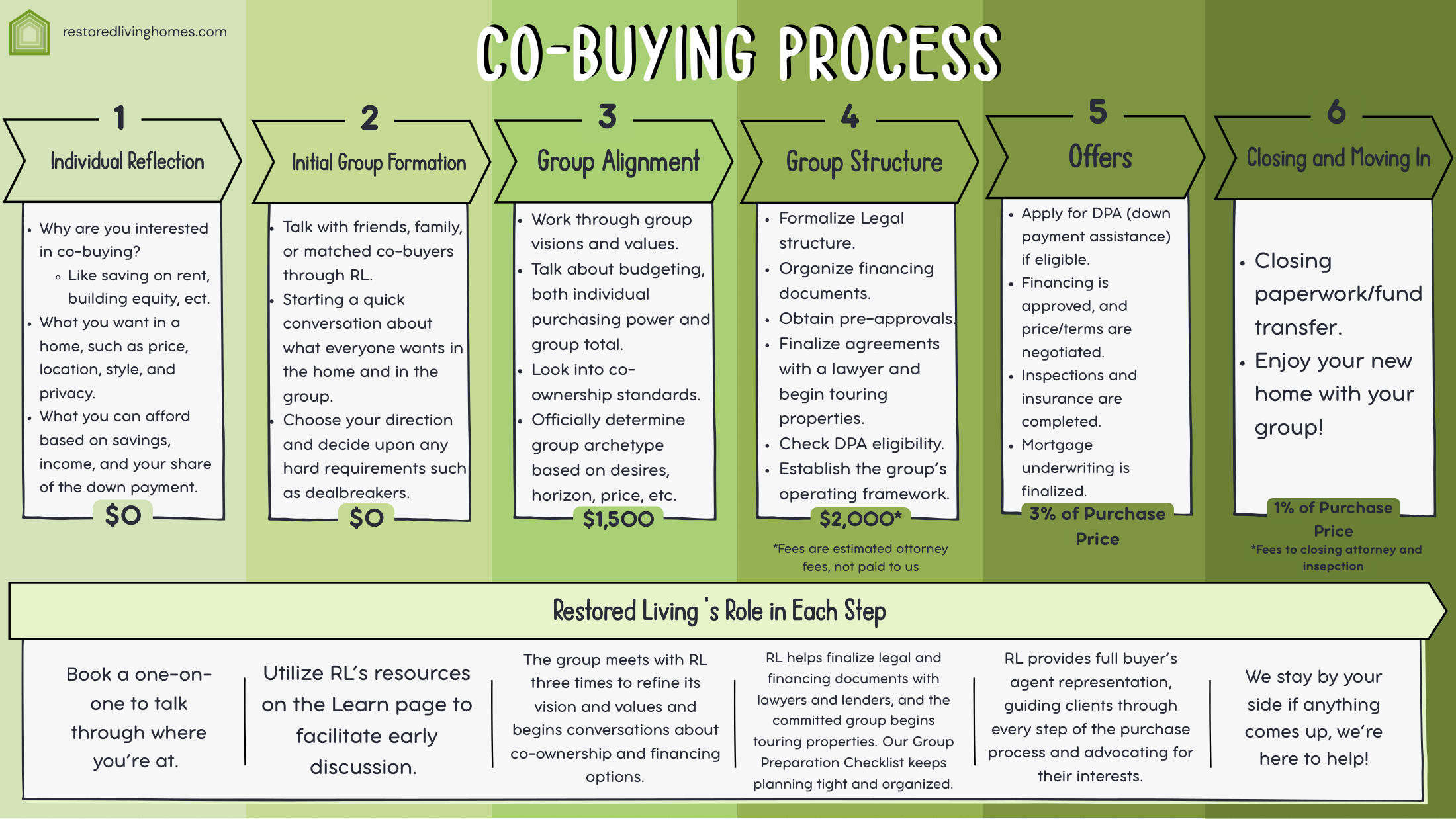
  1. Form a compatible group. Who you buy with matters more than the house itself. Co-buyers need to align on finances (income, savings, credit), living preferences, ownership timeline, and exit expectations before searching for a property. Misalignment here is the leading cause of co-ownership conflict — not house selection, not legal structure. You don't need to be close friends; you do need to be honest.
  2. Choose how you'll hold title. The most common structure is a Tenancy in Common (TIC): each person owns a defined percentage of the property and can get their own individual residential mortgage, preserving access to FHA loans (as little as 3.5% down on owner-occupied 2–4 unit properties) and Massachusetts down payment assistance programs. The alternative — an LLC — provides liability protection but requires a commercial loan at 20–30% down and 8–10%+ rates, and eliminates access to most DPA programs. For most first-time owner-occupants, a TIC is the financially advantaged choice.
  3. Secure financing — you qualify as a group. In a TIC, co-buyers apply together and lenders evaluate the group's combined income, credit, and debt load. Pooling your qualifying power means you can access properties none of you could afford alone. For 2–4 unit owner-occupied properties, FHA loans start at 3.5% down; conventional financing typically requires 10–25%. Massachusetts offers targeted assistance for co-buyers: the Boston Co-Purchasing Pilot provides up to $50,000 per household as a zero-percent deferred loan.
  4. Draft a co-ownership agreement before you close. This is the most underestimated step. The agreement is a legally binding contract covering: ownership percentages, how monthly costs are split, which decisions require unanimous vs. majority agreement, buyout clause mechanics (right of first refusal, how a departing owner's share is valued, the timeline for payout), and dispute resolution. Have it drafted or reviewed by a Massachusetts real estate attorney. Don't skip this because you trust your co-buyers — co-ownership succeeds precisely because the rules are clear before they're ever needed.
  5. Close, then build the operating structure. At closing, all co-buyers sign the mortgage note and the deed is recorded in your chosen title structure. After move-in: open a shared account for common expenses, fund a maintenance reserve (1–2% of the property value annually is the standard), and set a schedule for annual financial reviews. Multi-unit properties work especially well — each owner has their own unit while building costs are shared. The agreement governs the hard moments; the habits you establish in the first six months determine whether the partnership thrives.

Why It's Different from Renting

Feature Renting Co-Buying
Equity ✗ None ✓ Build real equity
Monthly Costs ✗ Rising every year ✓ Fixed mortgage + equity
Control ✗ Landlord decides ✓ You're the owner
Tax Benefits ✗ None ✓ Mortgage interest deductions
Stability ✗ Can be evicted ✓ Long-term security

Common Concerns Addressed

Life changes, and we plan for that from day one. The simplest path: a co-owner can rent out their unit and we help manage it, so they continue benefiting from appreciation without needing to sell. If someone needs to fully exit, that's covered too. Before moving in, your group chooses one of three exit paths that works for everyone: the remaining co-owners buy out the departing person's share, a replacement co-buyer is brought in through the Hub, or the group agrees to sell the property. You set the terms upfront, so there's no guesswork if the moment ever arrives.
Co-ownership agreements cover all major decisions: renovations, refinancing, sales, lease terms. Think of it as a prenup for your home. Our legal templates are designed by housing experts and adapted to your specific situation.
Yes. Co-buying uses standard real estate law: tenancy in common, joint tenancy, or equity partnerships. Our platform structures everything through established legal mechanisms. You'll work with a real estate attorney to finalize documents.
Not necessarily. Co-buying lets you pool qualifying power. Lenders evaluate the group collectively, so stronger credit from one co-buyer strengthens the entire application.

What else can we answer?

Insights & Perspectives

✍️
Co-Ownership 4 min read

Introduction to Idealia

What if the answer to our housing crisis is simply a change of perspective? Meet Idealia — a new voice exploring what Restored Living really means.

Read more
$$$
Affordability 5 min read

The Financial Case for Co-Buying a Home

In Massachusetts, the median home price exceeds $650,000. A traditional down payment is out of reach for most professionals.

Read more
❤️
Health 4 min read

How Your Home Affects Your Health

Americans spend 90% of their time indoors. Research links housing directly to physical and mental health outcomes.

Read more
🤝
Community 4 min read

Why Community-Centered Housing Is the Future

The loneliness epidemic isn't abstract. It's structural. The way we build and buy homes isolates people by design.

Read more
📈
Affordability 5 min read

Financial Leverage in Co-Buying: How Shared Ownership Builds Wealth Faster

Pooling resources to access property you couldn't afford alone — and compounding equity far earlier. Here's how it works in Massachusetts.

Read more
🏡
Case Study 6 min read

Accessing a High-End Neighborhood while creating instant Equity

Two couples co-buy a duplex on a quiet Arlington street — each unit fully private, purchase price split, and instant equity from day one.

Read more
🏘️
Approach 8 min read

The Village Was Always the Answer

For most of human history, no one bought a house alone. We didn't lose the village by accident — we were sold something different. Here's why co-buying is just going back to basics.

Read more
🔑
Affordability 6 min read

Why You Keep Renewing Your Lease

You renewed on autopilot. Most people do. But every year you rent, someone else is collecting the two biggest financial advantages in real estate. Here's what that's costing you.

Read more
🏙️
Community 5 min read

Three Things Wrong With How We Live

We spend $3,000 a month to live indoors, alone, and stressed. The affordability crisis, the loneliness epidemic, and the health crisis all have the same root cause — and the same fix.

Read more

Ready to explore co-buying for yourself?